Muxflow is now 100% native GPUI
Muxflow is officially 100% native GPUI, no more Tauri.
Let’s start with the results
- 76.5% lower idle memory usage
- 60% lower idle CPU
- Time to first terminal prompt (cold): 72% faster
- Time to first terminal prompt (warm): 80% faster
- Typing latency p95: 34% faster
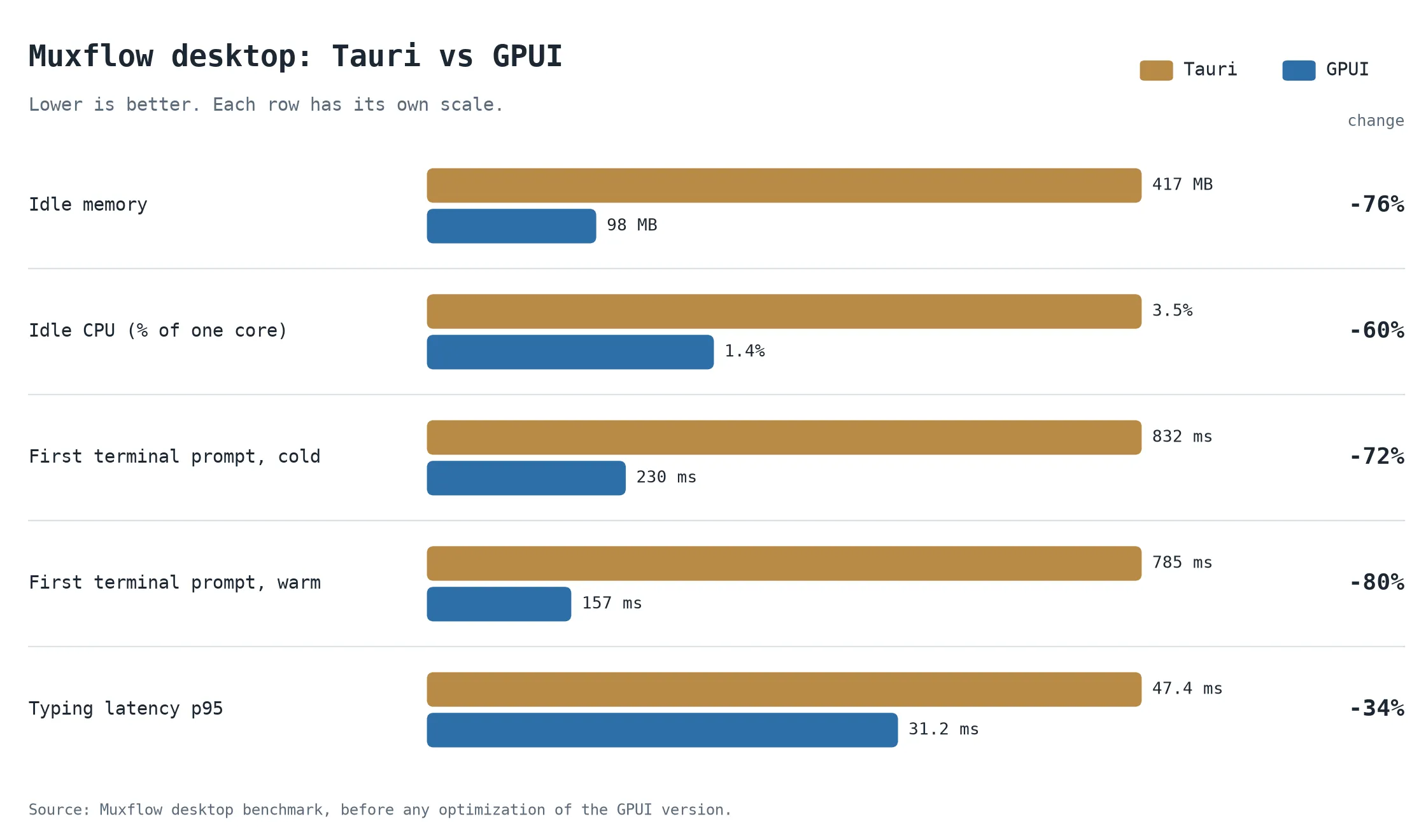
And that’s before any optimization of the GPUI version.
Why do the migration?
Because I can! LLMs allow you to pursue excellence and explore new areas without a strong reason.
This migration would be a strong no-go without LLMs. Yes, the numbers are much better percentage-wise, but muxflow was thin to begin with, so the raw numbers are a few tens of megabytes/ms in RAM and startup time. And pre-LLM the cost would be huge! Writing the whole UI in Rust vs the familiar React?
But with LLMs, the cost goes away to just some tokens. And with that I get:
- Much better performance
- A codebase that is 100% Rust (beyond mobile)
- No finicky Tauri rendering differences between Mac and Linux
- Push the envelope (for me) on what software engineering with AI looks like
The ugly
There is some ugly in all of this, mainly things I can probably figure out with a few AI sessions.
Library ecosystem
The GPUI third-party crate ecosystem is very niche compared to React. With Tauri I used CodeMirror - a well-respected lib. With GPUI I couldn’t use any available crate, as the Zed libraries are GPL licensed and Muxflow is MIT (and Rust compiles all libraries into one binary). There could have been easier legal solutions (including making muxflow GPL, not sure if anyone would care), but with the magic of LLMs I just created my own lightweight markdown WYSIWYG and code editor. Again, just a few more tokens! (Note to myself - see if there is value in publishing those as separate crates.)
CI and build times
Rust build times are rough, and it’s hard to run many agents in parallel, as parallel builds and tests put heavy I/O pressure on the machine. I’m sure it’s fixable, as I made no optimization attempts.